
Na Vosa Vakaviti
Although we can’t teach you the whole Fijian language on this page, we can certainly give you some information about it! There are over 300 dialects of Fijian language in Fiji that are spoken across a wide variety of regions, islands and villages. The bauan dialect is commonly spoken by all but some variations almost sound like entirely different languages! Fijian is the first language of around and estimate of 450,000 Indigenous Fijian people and it is essential to engage with if you are to have any understanding of indigenous Fijian culture; language is a window into how people see the world, how they express themselves and even begins to shape how people think because of concepts contained within them… there are plenty of Fijian words can’t be directly translated into English.
If you would like to learn some key phrases, head to ‘Travel Preparation’!
History
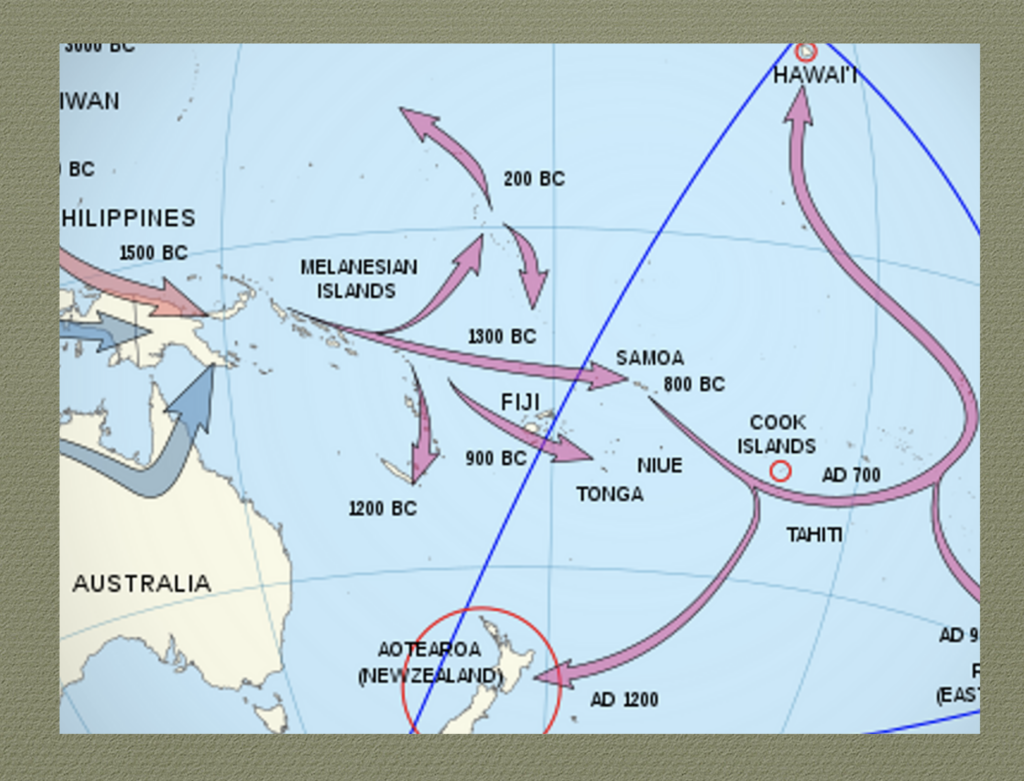
The Fijian language is categorised as an Austronesian language, sharing lots of characteristics with neighbouring Melanesian and Polynesian countries. The development of this particular language can be followed alongside historic migrations by the people who have now been settled in the Pacific Islands for centuries. The image above shows the migrations of all populations across the Pacific, the initial migration beginning in Eastern Asia and sweeping East. These migrations would have started with the Lapita people over 3000 years ago with many other migrations following; Fiji being numerously settled in around 900BC and New Zealand being the most recent, with Maori populations only arriving on the shores around 700-800 years ago.
In the migration of people, the development and change of culture is a natural process and as culture develops and changes, what is left behind is a snail trail of influence that begins to evolve in certain areas after being exposed to distance for a period of time. This is why neighbouring countries can be seen to share similar customs and cultures yet also remain unique. This can be seen clearly in the Pacific history and culture today. This would include customs and traditions, religion, pottery, art expressions and language.
The chart below shows this clearly, with five different languages being analysed following a historic migration from West to East:
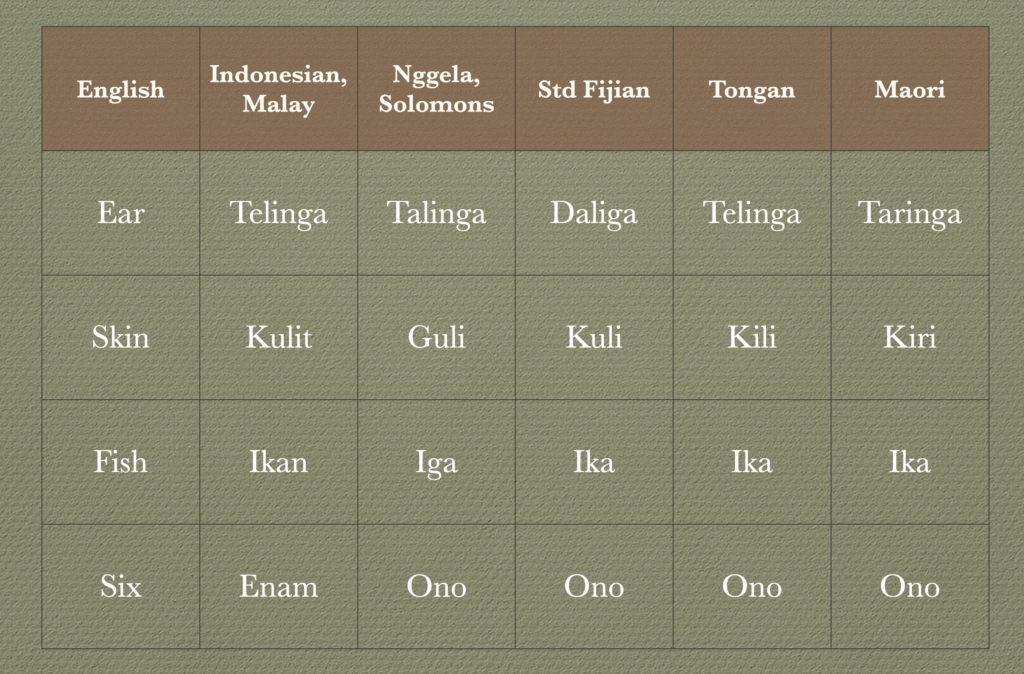
You should be able to see the development of the languages, similarities and differences!
Orthography
Before the intervention of Western missionaries, Fijian was never written down! Nothing in pre-colonial Fiji was written and everything existed in an oral tradition. This is why Fijian nowadays uses the latin alphabet, with certain sounds that don’t exist in English being adopted by letters who’s English sound does not exist in Fijian.
This all occurred by Methodist mission efforts in the early 19th century. In 1825, Christian mission was already well established in Tahiti and Tonga, and it is through these bases and successes that made Fiji plausibly accessible.
William Cross and David Cargill were the first missionaries to move to Fiji with their families to Lakeba in 1835 with the help of converted Tongan teachers and a parade sent by King George of Tonga.
Both Pacific mission veterans spoke enough Tongan to be understood in this region as the Tongan population was almost equal to Fijians. They studied the Fijian language and taught the local people orthography, to write the newly devised written system of Fijian in the latin alphabet in English and their native tongue. This was soon to be boosted by the arrival of James Calvert, John Hunt and Thomas Jagger in 1838, who brought with them a small printing press to be used to print books in Fiji, predominantly the Bible, translated into the indigenous language.
Some Further Context…
Here’s a fascinating interview with Dr Paul Geraghty of the University of the South Pacific, the world leader of Fijian language and cultural studies explaining the history of the Fijian language and the significance of its study. He also shares his insights on the broader concepts of culture and assures us that it is vital to understand language if you are to fully understand a culture.