
Some Contextual Insights to Contemporary Fiji
This section aims to give you an opportunity to learn about the contempory way of life fo Fijians, Fiji’s socio-political context and an opportunity to see how Fiji has changed from the days of old.
Comparison: Fiji of the past, Fiji of the present
Watch These Two Documentaries on Fiji:
A documetary looking at the Fiji in the 1940. Remember, this documentary was produced when Fiji was still part of the British Empire. It focuses on giving an overview of Fiji’s economy and population.
This is far more recent documentary by the BBC. A general overview is given between (00:00-10:11). Then moves on to focus on the areas of education, sport and culture, climate change, politics and economy and health and medicine.
What changes are immediately obvious? What challenges are evident for Fijians today?
Fiji’s Economy
Economically, Fiji is full of contradictions. Its natural resources make it one of the healthiest economies of the Pacific Islands, but much of the population survives on subsistence farming. The farming and processing of sugar constitutes the bulk of the country’s industrial activity. Estimated gross domestic product (GDP) in 2017 was US$8.629 billion, with agriculture contributing 13.5 percent, industry 17.4 percent, and services 69.1 percent.
Industry
The two mainstays of the Fijian economy are the sugar and service industries. In 2018, 38.6 percent of the workforce was employed in agriculture. The demand for Fiji’s forest resources has increased significantly.
Industrial pursuits include mining, manufacturing, and construction. Gold, gems, and petroleum are the main exports of the mining and extraction industry, while the garment industry is the flagship enterprise of the manufacturing interests. Food and beverage processing are important industries in Fiji as well.
Agriculture
A large number of Fijians participate in subsistence-level farming and produce no goods for export. There are also large commercial plantations that grow sugarcane and coconuts. Sugarcane is the most widely grown commercial crop, while rice is widely grown by subsistence farmers. Fijian farmers also raise cattle, hogs, chickens, and fish.
Tourism
In 2018, an estimated 870,309 tourists visited Fiji, according to the Fiji Bureau of Statistics. That year the tourism industry was responsible for 38.9 percent of the GDP and 35.3 percent of employment. The main attraction for tourists visiting Fiji is Nadi, on the western side of Viti Levu. It relies almost entirely on income from tourism and, as such, offers nearly everything a tourist could need. Many of the smaller islands provide excellent snorkeling and other outdoor activities.
Education System
Officially, education in Fiji is mandatory for children beginning at age six. Primary school lasts six years, secondary four, and upper secondary three. However, although primary education is free, associated fees and expenses prevent some children from attending. The 2013 constitution stipulates that the government should “take reasonable measures within its available resources” to ultimately introduce “free early childhood, primary, secondary and further education.”
Recent Political Unrest
Fiji’s political history has certainly not been simple. Major political events include the shifting from the old ways of land governance to being ceded to Queen Victoria in 1874 to be part of the commonwealth, as well as the resurgence of patriotism that led to the day of independence in 1970 where they broke away from this very rule. Abrupt moments in history like these born from tensions between the old and the new made Fijian politics volatile, with many questions about identity and rule unanswered and integral issues within society not dealt with.
Check out the Indo-Fijian Culture section for more info in this subject
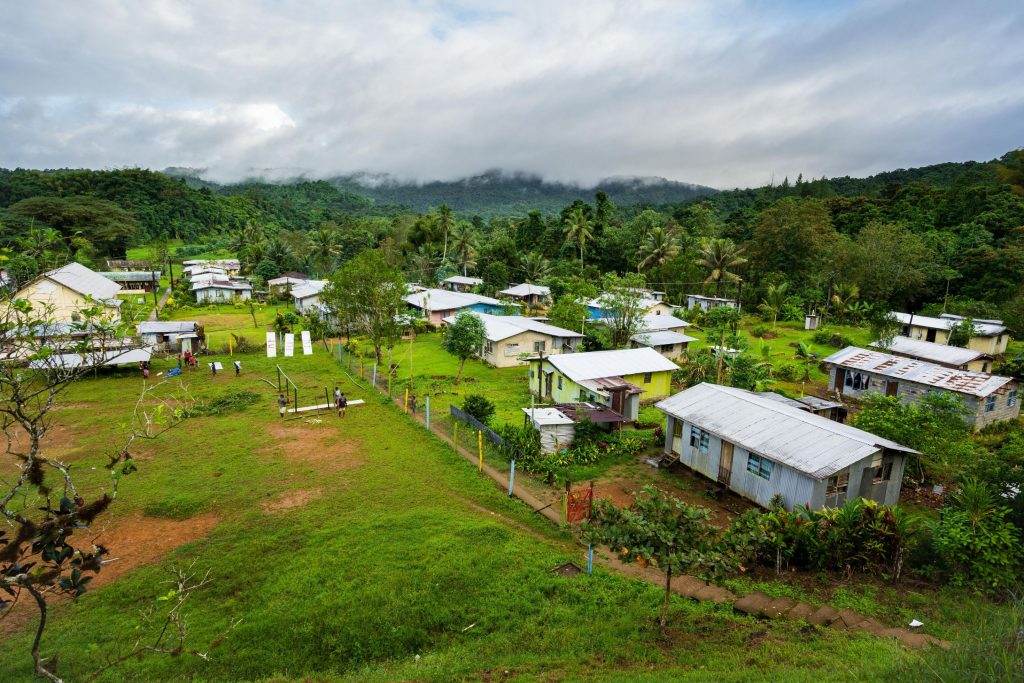
The Politics of Vanua
An immediate challenge that becomes obvious is the political struggles that Fiji has experienced in recent times. The claim to the ownership of land, the very connection to this sense of togetherness, has caused political rifts in Fiji’s history. The tensions between the Indo-Fijian population and Fijians really comes down to this idea of belonging as the Indo-Fijians are not traditionally believed to be a part of or have any ownership of the vanua. It has been a source for debate as to whether the concept of vanua was used as an excuse by far-right nationalist in the coup d’états of Fiji’s recent history, but whether it was or wasn’t, it stands as a reminder of the rift between the two largest ethnicities in Fiji.
Documentary on Fiji’s Coup History
This documentary from 2006 deals with the issues at the heart of Fiji’s military coup d’états. It includes some fascinating interviews and offers a really powerful insight to the problems at the heart of the political strife. This particular documentary was released ahead of the general election of 2006 and before the latest of Fiji’s coups. It features interviews with Frank Bainimarama, the current Fijian Prime Minister before he rose to that position.
Social unrest, with the divisions between racial groups often taking the blame, has led to military coups featuring in Fiji’s recent history. Two 1987 coups saw the overthrow of the elected government of Fijian Prime Minister Timoci Bavadra, the deposition of Queen Victoria II as Queen of Fiji and the declaration of Fiji as a republic. These were initially blamed on the social tensions between the two major ethnic groups of Fiji and the 1987 general election really became an ethnic Fijian vote vs Indo-Fijian vote with similar numbers on either side.
The result of the 1987 general election left a multi-ethnic labour coalition supported mainly by the Indo-Fijians in power in government replacing an indigenous-led conservative government. After much disapproval of this democratic decision amongst indigenous Fijians, the military staged a coup and disposed of the elected government.
The 2000 coup was a similar story, seeing the elected prime minister of Indian descent, Mahendra Chaudhry, overthrown by a civilian coup of right-wing nationalists.
After Commodore Frank Bainimarama declared martial law and resolved the crisis by force, he assumed power in an interim government.
The 2006 coup really resulted from the tensions remaining from the one in 2000 and after the political pressure of the complex 2005-2006 political crisis. This particular coup d’état again involving the military taking command of government resulted in Frank Bainimarama becoming Prime Minister. He remains Prime Minister to this day and is taking steps to outrule racism in Fiji.
Current Situation
Today, there is peace in Fiji. Racial tensions are being tackled slowly but effectively by the current government with Frank Bainimarama as Prime Minister. Recent legislation to remove the constitutional discrimatination of Fijians of Indian decent now allows them to be known as ‘Fijians’ first and foremost rather than ‘Indo-Fijians’. This is an important step forward in the equal treatment of all citizens in Fiji.
Some Further Reading…
Article on Coup Culture in Fiji – Here’s an article urging Fiji to acknowledge its ethnic makeup in order to achieve greater political stability.
Economic situation before and after the coup – An academic journal entry covering the major economic implications of the coups.