
Self Leadership and Management
What is Self-Leadership?
In a recent definition, self-leadership is…
“The practise of intentionally influencing your thinking, feeling and actions towards your goals and objectives”
Bryant & Kazan, 2012
There’s no finish line in self-leadership – and it doesn’t happen by accident! Continual self-leadership is generally regarded as a real mark of leadership maturity and it takes both effort and daily practice. There has been found to be a direct correlation between effective self-leadership and successful public leadership (Rima, 2000) – or more simply put, the way in which you conduct your internal ’self’ has a massive effect on your ability to exercise public leadership that involves other people.
And if you want an inspirational quote to go with that, in the words of the philosopher, Lao Tzu…
“Mastering others is strength. Mastering yourself is true power.”
“We Cannot Lead Others Without First Leading From Within” – Lolly Daskal
👈 Watch this video
In the video above, Lolly Daskal is a globally renowned executive leadership coaches. She is founder and CEO of Lead From Within and her leadership program aims to be a catalyst for leaders who want to make a meaningful difference in their companies, their lives, and the world.
In this Ted Talks Lolly talks about why Alexander the Great got his title… “He was able to conquer an instinct that most of us have, and that instinct is to think that Leaders are superior. What he understood, so profoundly, is that leaders aren’t great because they have power, but that leaders are great because they can empower others.”
But what does it actually look like?
The ‘10 qualities of Self-Leadership’ are identified as:
| Curiosity | Honesty | Accountability | Self-discipline | Humility |
| Courage | Self-compassion | Assertiveness | Willingness | Inner Faith |
People who have a strong sense of self-leadership (even if they don’t know it) tend to be those individuals that others naturally gravitate towards. It’s not because of arrogance or vanity – but rather because they possess the characteristic that ties all of the 10 above qualities together…
The role of Emotional Intelligence
Daniel Goleman, a Psychologist and journalist for the New York Times, highlighted the five characteristics of emotional intelligence as the pivotal skills of ‘What Makes a Good Leader’. Those include self awareness, motivation, empathy, social skills and self-regulation…
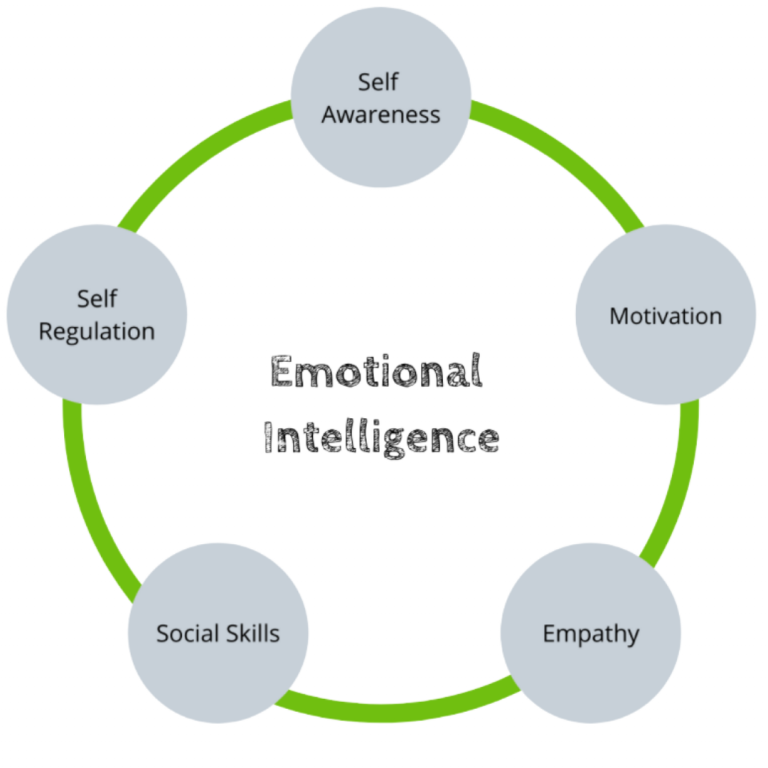
- Self Awareness: acts as the foundation of both emotional intelligence and self leadership. It is the ability to recognise and understand our moods, emotions, drives and how those can affect others.
- Motivation: by this we don’t mean external motivations like food or possessions. Rather it refers to our internal motivation – the commitment to actualize our potential, capacities and talents – and pursue these with commitment.
- Empathy: this is the ability to understand the emotions of other people. As humans we all come hard-wired to experience the same emotions and the more we can understand and consider our own emotions, the better we can exercise empathy towards other people and what they are feeling themselves.
- Social Skills: are defined as the ability to find common ground, build rapport, manage relationships and foster networks with others. Someone with good social skills can influence and persuade other people and lead them towards change.
- Self-regulation: refers to the ability to control disruptive impulses and moods – more simply put, to think before acting. This doesn’t mean repression or dishonesty, as personal integrity is also an important factor in leadership. Instead self-regulation is about being open to change and considering how our behaviour may affect both ourselves and those around us.

How can we improve our self-leadership?
If self-leadership is all about aligning our body, emotions and thoughts towards our goals, cultivating both our self-awareness and emotional intelligence is the best way to improve our self-leadership. However, there are plenty of ways we can work on these skills – here are some really simple tools and activities we would like you to try:

Develop Self-Exploration
Try taking the Myers Briggs Personality Test.
Read up on your personality profile…
- What rings true?
- What makes you feel defensive?
Sit with those feelings for a while and reflect on what this means to you about self leadership.
Reconnect through Grounding Techniques
- Cover the crown of your head with your hand for a minute
- Place all of your awareness on the bottom of your feet for 30 seconds
- Breathe through one nostril and out through the other for 1-5 minutes
- Stand in a power pose – feet shoulder width apart, spine straight and chin tucked in
- Take a cold shower
- Lie on the floor and press your palms into the ground of 5 minutes


Use the Power of People
…Remember, that we are only as strong as the team around us! Whenever possible discuss and collaborate with…
- Your team
- Project managers
- Community members
Identify your strengths and weaknesses
- Make a list of the characteristics you think will be beneficial to the role and another list of things you think you could find challenging
- Take the VIA Institute on Character ‘Strengths and Weaknesses’ survey to see if that matches your expectations…

‘Lead from within’
We’re bringing Lolly Daskal (from the first video) back up again, the author of “The Leadership Gap” and “Lead from Within.” She offers 12 guidelines for effective self leadership. All of these directives revolve around how to connect with ourselves and our vision, and then extend that to connect with other people. Let’s look at the 12 guidelines, and how those relate to your experience with Think Pacific…
| Leading from within | Examples | TP Value |
| 1. Set goals | Try to set daily, weekly and project long goals tied to your vision of leading. Once you’ve set your goals, ask yourself every day what you’re doing to reach them – both personally and as a leadership team. | Aspiration |
| 2. Lead by example | As a leader, you are setting an example for those around you everyday. Mindset, motivation, cultural standards, project engagement, whatever it is your behaviour is the standard others will adhere to – so what standard are you going to set? | Mindset |
| 3. Be fearless | Be willing to fall down, fail and try again. Everybody make mistakes (even as a leader) so things are definitely going to go ‘wrong’ at some point. However, being a leader is about not being afraid of making mistakes, but learning from them when they happen. | Resilience |
| 4. Honour others | As a leader, you have to learn to give credit and validation where it is due. Did the team achieve an amazing workshop? Did another leader work tirelessly to organise an evening activity? Instead of seeking recognition, offer it to the people around you and show appreciation! | Humility |
| 5. Embrace new ideas and opportunities | Don’t shy away from the new. Everything was impossible until the first person did it. At Think Pacific Fiji projects were just an idea before they were actualised… this virtual internship was only born last year after some rapid brainstorming and serious determination. Accept that new opportunities are how we grow. | Passion |
| 6. Question everything | The more you ask questions the more that you will understand and develop. Strive to increase your knowledge, skills and understanding – that way you will get the most out of this leadership position. | Aspiration |
| 7. Do what is right not what is easy | Personal integrity cannot be underestimated in leadership. Likewise, when it comes to TP’s integrity and ethics, there’s no room for compromise. This might mean having difficult conversations, but in the long run you will gain more respect by doing what is right over what is easy or personally beneficial. | Accountability |
| 8. Surround yourself with mentors | Always be on the lookout for teachers and mentors who are more experienced than you. If you think you’re the smartest person in the room you cannot grow. Don’t let personal pride stand in the way of being inspired by others. | Collaboration |
| 9. Find goodness around you | It can be easy when we’re overwhelmed to slip into negativity. Take some time to seek out the beauty around you and try to practise gratitude. | Resilience |
| 10. Actively reject pessimism | There will always be something to be negative about in life. Practise a zero tolerance attitude for personal pessimism. The more you reject this mindset the more space you then leave for positivity, which will rub off on the people around you. | Mindset |
| 11. Be the change you want to see | As a leader you get the unique opportunity to help other people work towards a vision that is larger than all of us. In the words of TP legend, Manasa: “dream big, start small, act now”. | Aspiration |
| 12. Care for and about others | If you make sure that compassion and empathy are central to all of your decisions, then you can’t go too wrong! This will also enable you to make key decisions and actions that will positively impact volunteers and community members based on their needs” | Collaboration |

Self-Management
In the quadrant of effective leadership, it’s easy to get swept away with the ‘big picture’ stuff – the vision that we’re inspiring both ourselves and other people to work towards. That stuff is essential when starting out on developing our skills as a Leader, but it is important to consider the more practical side of being a Leader too.
Now we know self leadership revolves around intentionally influencing our thoughts, feelings and actions towards an objective – then what are the tangible, pragmatic steps to actually action this objective?
This more practical side of life is the world of management – and we will look at how that can combine with the big picture stuff to form a comprehensive skill set of a leader. So, within the quadrant SELF-MANAGEMENT refers to:
“the idea that we can take an active role in regulating our own performance – through goal setting, monitoring behaviour related to these goals, and rewarding ourselves for goal achievement”
Much like self leadership is the foundation for team leadership; self management is, you guessed it, the foundation for team management. In fact, it’s thought that “self management is the basic prerequisite for the effective management of other people, groups and organisations” (Luthans & Davis, 1979).
So what are the things that make up successful self-management? Well, mainly it stems down to personal responsibility and how we take ownership over the tasks that we need to achieve. So without further ado, let’s talk about the core skills of self-management, applied in a Think Pacific setting…
Self Management Tips