

Saviourism
When undertaking any ‘development’ project in the international space, particularly between the Global North and Global South, saviourism is a topic that must be engaged with fully. This is in the interest of supporting genuine impact through any initiative but also, potentially more importantly, on ethical grounds. Not only is this an important complex to comprehend on a mindset level, it is important to bring a critical eye to the conduct of how this is manifested in multiple areas of international exchanges. On this page, we look at a definition of saviourism, ways of identifying it, examples of malpractice and finally some practical pointers for how to begin to deconstruct it.
What is Saviourism?
Saviourism points to the dynamic that in the Global North, the Global South may be defined as having a problem and the global citizen or humanitarian from the North is constructed as providing the solution to that problem. That is to say, individuals, institutions or economies from the Global North must ‘save’ the Global South from their suffering and hardships… as you can imagine, this is rightly a hot topic of debate in the International Development sector.
In reality, when relating this to small scale international humanitarian projects, the ‘saviour’ mentality means that ultimately the citizen from the Global North may want to help others but, due to engrained and internalised notions of societal hierarchies which may have established a sense of superiority among people in the West, they are not open to nor prioritise guidance from those they want to help; it is a form of false generosity which maintains and embodies supremacy. This ultimately creates a dynamic where saviours may at least subconsciously believe they are somewhat in a position of superiority to the people they are ‘rescuing.’
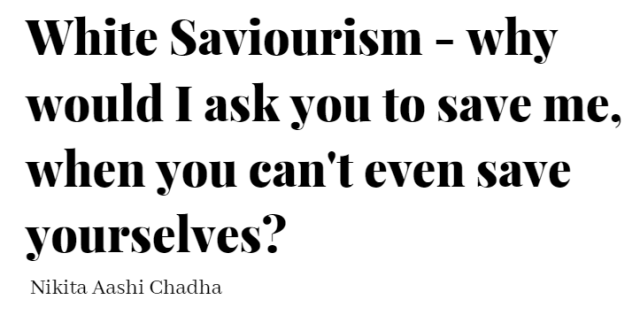
The roots of this mindset largely derive from the parameters of colonialism and the injustices this encompasses. When engaging with ‘development’, it is not just your actions that you need to consider but you also need to have an awareness of the historical context, culture and power dynamics that exist in this space.
The concept in the international space is very much related to the turn of phrase, ‘White Saviourism,’ and although this comes with the criticism of being racially reductionist and sweeping, the historic ties to particularly White European Supremacy cannot be ignored and it would be an injustice to sweep them under the cover. The connotations of the phrase ‘White Saviourism’ align exactly with those in the wider sense contained in the entire Global North but adds an edge in rhetoric, highlighting history and contemporary cliches. This notion in particular is often perpetuated in popular media. The videos below may be helpful if you’re still struggling to get you head around this!
For an overview of what white saviourism entails, have a watch of this:
For more depth in how this relates to international development, watch this:
Identification
To avoid falling into the trap of manifesting and portraying these power dynamics, a serious act of critical thinking is required. This reflection is sometimes uncomfortable, but is incredibly important for individuals to grow and become more aware of themselves and the world around them.
It is your duty to expand your knowledge on racism, white supremacy, as well as white saviourism prior to working in the Majority World.
A Scientific Framework for Compassion and Social Justice, Jacob A. Sadavoy
Simply put, saviourism accompanies an implicit racism that stereotypes one group into a box and inevitably views them accordingly. This may not always be intentional, instead as a result of the internalisation of societal narratives that have been around us for our entire lives… we all have implicit biases and reflecting on what they are allows us to be more open minded and open to learn and develop.
Saviourism is in part a projection of an internalised racism; this is unconscious. Internalised racism describes a belief system built on the acceptance of negative stereotypes of a group of individuals, particularly non-whites. It leads to structural inequality that is highlighted through concepts such as own-race bias. This does not mean anyone is bound to act in line with what negative stereotypes would dictate; continuous self-reflection on one’s own actions and thoughts and elevated self-awareness aid in the deconstruction of internalised biases.
Try this simple test below to test your yourself!
We need to create space for voices outside of the circles we are used to.
Angela Bruce-Raeburn
As part of this process of identifying one’s biases and removing yourself from your own perspective bubble, although holistically impossible, try to imagine the perspective of those who are the subject of this aid… what might they think/feel, how would this affect their own views of their lives in relation to others and how might this be received? How might you feel if someone where perpetuating an attitude of saving you?
The video below is a parody and highlights the Eurocentric narratives around aid which can present the West as a paternalistic superpower that models of development in the south need to be based on. The parody highlights the way in which the West can place itself as a saviour, denying the agency of the people it seeks to help.
The “Africa for Norway” video spoofs the Band Aid single, “Do they know it’s Christmas?” which was produced to raise awareness of famine in Ethiopia in 1984, and has since become a classic Christmas song. In the song, the particular situation of a food crisis in Ethiopia is dehistoricized and depoliticized as simply a natural disaster. Ethiopia isn’t mentioned at all in the song, and so “Africa” becomes the site of despair, to be remedied through “our” pity. Now, nearly 30 years later, the context of the song is even more distant, and so the song’s lyrics seem even more degrading and insensitive than they did at the time it was first performed: There’s a world outside your window / and it’s a world of dreaded fear; there won’t be any snow in Africa this Christmas; Where nothing ever grows, or rain or rivers flow; feed the world, let them know it’s Christmas time.
In this parody, by turning the tables (to draw on the lyrics of the song), and showing how simplistic and inaccurate the “African” depiction of Norway is, folks in Norway, and in Europe and North America more generally, are to make the connection that maybe our representations of “Africa” are similarly simplistic and inaccurate. This parody highlights the fact that aid must be based on needs and not good intentions. It speaks to a wider issue, where white people in the west perpetuate a sense of superiority by suggesting people need to be saved and oversimplifying contexts in which this is the case.
Examples of Malpractice
Misguided Voluntourism
Here are two Ted talks that explain how learned helplessness, destructive ‘voluntourism’ prevents those in ‘deprived’ countries from learning themselves. They may become reliant on international support rather than being empowered through these volunteers to create a sustainable living. They further discuss how misguided voluntourism leads to financial maltreatment and physical maltreatment comparable to modern slavery. When volunteering, understand the needs of the country and your capabilities, consider the limits of your value and help in the small ways that you can from your privileged background. The focus is shifted to genuine empowerment of communities to live sustainably rather than simply putting bandage on it until the next set of volunteers arrive, this begins to remove the worst connotations of the saviourism complex and instead promotes value in the culture, highlights the recipients of International development as the hero of their own story and that the people are there to just give resources to aid in that transition.
#WEscandle
Here’s an interesting read on what was learned from a scandal around white saviourism drawing upon the #WEscandle and how it tarnished the representation of the company. It draws upon how saviourism is normalised and why this is a problem using key points from the scandal…
Teju Cole – Industrial Complex
An interesting article where it discusses how many inequalities and maltreatment is treated as an external issue not one that anyone wants to admit they are a part of…
Avoiding Saviourism
Identifying the tropes of saviourism is important for anyone at risk of reinforcing this dynamic in their international encounters, but there are also some steps that can be taken to consciously assist the deconstruction of this complex and avoid the negative connotations that it can portray. We at Think Pacific do not have all the answers, no-one does, this is a contemporary and shifting complex that is in constant need of re-examination… but we can offer some thoughts on the subject for your own application as well as organisational and industry culture. Below are some thoughts that can relate directly to your experience with Think Pacific or your life in general beyond.
Structural Awareness
1.
It is important within this discourse not to set a narrative that reinforces binaries like ‘us/them’ and ‘developed/under-developed’, as this terminology perpetuates a sense of ‘primitivism’ around the Global South and post-colonised countries like Fiji. We need to connect directly with an exploration of our own subjectivity, representations and locatedness when engaging with the legacies of colonialism so that we can address our own individual roles within the process. Even referring to countries as ‘under-developed’ can feed into this idea of saviourism as it suggests that the development of the West is a fundamental goal which needs to be adopted by other countries. A more appropriate term being adopted in the humanitarian space is ‘majority world’ which acts as a reminder to the west that in fact it is only a fraction of the world and it must not impose ideologies.
2.
There needs to be a recognition that when joining or supporting any international project in ‘development’ that it must be supporting the genuine requests of those it aims to assist… if humanitarian aid is to be transformative, then aid must be a tool for governments to provide the needs of their people. This means that international development takes the form of essentially becoming resource distribution with its actualisation being guided by the discretion of local organisational bodies. An international development effort undertaken by a Western country with a particular agenda denies agency to the country in subject, it is tainted by a perspective and reinforces harmful and restrictive power dynamics. When it is guided locally, the ownership of the resolution or direction of change is given to those it concerns.
3.
The purpose and nature of the use of comparatively unskilled labour needs to be addressed in any volunteering setting. If it is assumed that individuals from the West automatically have an higher opinion or assumed capacity for resolution compared to the thoughts of individuals in the country they wish to support, regardless of training and purely because of geographic background or skin colour, that is damaging to the model of empowerment, the opportunity for genuine impact and reinforces power imbalances. Check out the “Appropriate Approaches” section in this module to learn how Think Pacific goes about this.
Personal Checklist
- Research charity – not just the lovely website but also reviews and its actual impact and mission rather than its suggested impact. Find an organisation that puts the community at the centre of their approach, empowering them to move forward, and puts effective measures in place so that you as a volunteer are qualified/taught enough, or understand your role in your participation fully to actually make a positive impact while you are there.
- Consider and reflect on the real reasons you are joining an international project – joining an international project is an opportunity for personal growth as well as a chance to contribute towards what is hopefully a worthwhile project. But being honest about your true motivations, the weight of one side or another, reveals your mindset and helps you understand how you are thinking about the project and whether in any way you are being exploitative of the country exclusively for your own benefit.
- Critically reflect on your own capabilities, what skills do you have and what skills do you need before joining an international project – what are you bringing to the project and in what capacity? Why does this matter in regards to what we have reflected on within this page?
- Consider your action in-country and what message they portray – the way you behave in other countries is emblematic of your mindset and is what ultimately leads to the impact you’ll have. Eg. Have you ever seen a situation where a volunteer is taking photos of children they are working with for the purpose of sharing them on social media, without permission or consent. Do you think the same situation would unfold if they did so at home, with children they didn’t really know? What does this say?
- Understand your own biases and seek information to correct them – biases are normal and are a part of life, we all have them which does lead us to be insensitive at times so please do look inward, take some bias tests and actively question what you might think you already know.
- Research the culture you are going to visit in depth – what is the language, what are the capitals of the country, what is the dress code, what is the belief in the community, what are the country’s development goals, how can you facilitate their empowerment so that they can do this without the need of volunteers, how has colonisation changed culture and what implications does this have for your perception in-country? All this research helps you be as respectful as possible.
- Be open minded to and aware of differing perspectives – learn how a unique way of life is valuable and a unique approach to development important. If your immediate response is one of pity, what does that say about your motivations and and how you will go about putting those motivations into action?
- Seek to understand before seeking to be understood – do not think that you know everything about what these people need, your solutions might not be the best way to help and therefore your work could be pointless. Start firstly by understanding.
- Believe in a focus on empowerment through context rather than just doing a job that needs doing – give people the tools and knowledge so that they can do this job in the future. Create jobs, create resources that can be used to teach more people so that the work you do lasts. But most importantly, appreciate what has already been done and why. There is no point in creating a “how to look after the forest 101” document if there is already resources available, consider how you can build on this and empower people further perhaps make a “how to look after the wildlife in the forest 101” document would be an example of this.
Fancy some further reading…