

Why is Reflection Important?
Reflection is vital as it helps us develop our skills through analysing what we have previously learnt and how we learnt it. In any setting, reflection is an important part of learning. This applies everyday; if you ended up using a recipe to make a disgusting meal you probably wouldn’t use it again and choose a different one next time! Likewise, in the workplace, reflection allows you to assess how close you have come to achieving goals, what worked particularly well and what would you change to get their more efficiently or successfully next time. Here’s a nice way of putting it:
Its power lies in being able to help you develop your understanding of the way you learn, the subjects you are studying and to define your longer-term goals. It can help to promote critical thinking and problem-solving skills, both of which are key to academic success. But it has further uses that relate to life skills: it is an essential part of personal development and prepares you for the world of work, encouraging you to develop the habit of analysing your actions or events and considering the consequences.
Gillett, Hammond and Martala, 2009, p.164
We all reflect everyday, but intentional reflection is something we really encourage at Think Pacific and will be something that you exercise during your time with us.
Understanding the Reflection Process
Here’s a simple way of thinking about reflection. Kolb’s Learning Cycle, as explained by learning pool, communicates the steps that people undertake when using reflection as a key factor in the learning process.
Kolb’s Learning Cycle:
Kolb’s Learning Cycle proposes that the opportunity to reflect on our experiences is vital to the learning process. By encouraging learners to reflect on the activities they have participated in, they are no longer just focused on the ‘how’ of their task or activity but also exploring why they are doing it.
The cycle proposes that, for learning to be effective, the learner must progress through a cycle of four stages.
Learners are required to complete each of the four stages. As the cycle suggests, reflection is futile if learners are not then applying these experiences and observations to their job-related tasks.
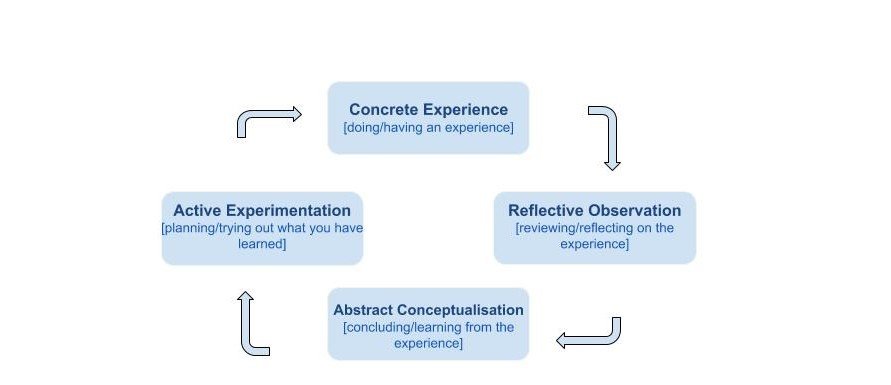
This model clearly shows that through action and reflection, individuals refine a skill through experience. Reflection offers the ingredient to recognise what was successful and what was less successful, what to do next time and why.
Ways of Reflecting
There are a few ways of reflecting on your performance. Below are a few you may wish to utilise during your time with Think Pacific:
Self-Reflection
As it says on the tin, self-reflection is taking the time to evaluate yourself. This is a very useful intentional practice because you know you best. You can not only analyse your own thoughts on whatever you are reflecting on, you can analyse how you feel about it too.


Peer-Reflection
Using your peers, friends or anyone else who can offer an honest opinion on whatever you ask is a useful tool as they offer a perspective that you actually can’t conceive of yourself. This can be eye-opening and provide insights that you may not have come to on your own.
Expert Reflection
Depending on what it is you are wanting reflection on, sometimes a neutral position isn’t enough to best learn how to improve. In this case, you may approach somebody already competent at that skill or possessing a certain experience that will be of value. This may well be a member of Think Pacific staff during your project.

Reflection and Goal Setting
Reflection becomes much more precise and beneficial when you are reflecting on something specific. By setting sharp, clearly defined goals, you can measure and take pride in the achievement of those goals through reflection, and you’ll see forward progress in what might previously have seemed a long pointless grind. You will also raise your self-confidence, as you reflect and recognise your own ability and competence in achieving the goals that you’ve set.
To provide a framework for successful goal setting and to avoid setting goals that are irrelevant, vague and unspecific, we like using the SMART goal setting system. The video below shows what we mean by this:

Specific – A specific goal has a much greater chance of being accomplished than a general goal.
Measurable – Establish concrete criteria for measuring progress toward the attainment of each goal you set. When you measure your progress, you stay on track, reach your target dates, and experience the exhilaration of achievement that spurs you on to continued effort required to reach your goal.
Actionable/Attainable – When you identify goals that are most important to you, you begin to figure out ways you can make them come true. You develop the attitudes, abilities, skills, and financial capacity to reach them. You begin seeing previously overlooked opportunities to bring yourself closer to the achievement of your goals.
Relevant – To be realistic, a goal must represent an objective toward which you are both willing and able to work towards. A goal can be both high, realistic and relevant; you are the only one who can decide just how high your goal should be and whether it is relevant to the activity and your own development. But be sure that every goal represents substantial progress. A high goal is frequently easier to reach than a low one because a low goal exerts low motivational force. Some of the hardest jobs you ever accomplished actually seem easy simply because they were a labour of love.
Timed – A goal should be grounded within a time frame. With no time frame tied to it there’s no sense of urgency. If you want to lose 10 lbs, when do you want to lose it by? “Someday” won’t work. But if you anchor it within a timeframe, “by May 1st”, then you’ve set your unconscious mind into motion to begin working on the goal.