

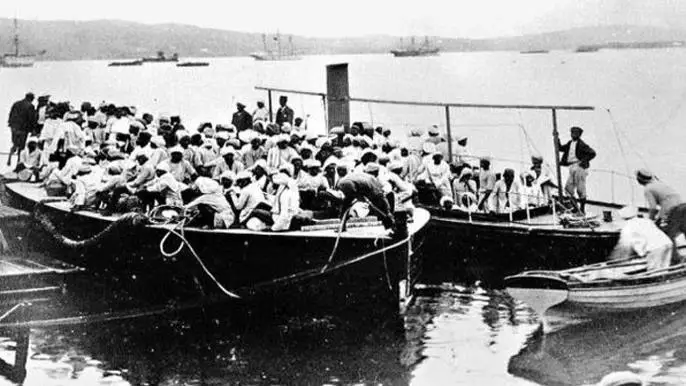
In the 19th Century, the Indian Indentured labour system was a form of debt bondage between British colonies. 3.5 million Indians were distributed amongst colonial powers to provide manual labour on plantations. From 1879 to 1916, around 60,000 indentured labourers contractually travelled from various parts of Colonial India to work in the sugar cane plantations of Fiji, through the promise of fair wages and good work.
Districts that provided more than a thousand recruits included Basti, Gonda, Faizabad, Sultanpur, Azamgarh, Gorakhpur, Allahabad, Jaunpur, Shahabad and Rai Bareilly. These areas suffered immensely with illiteracy, poverty, famine, drought and unemployment. This made recruitment to the indenture system easy for the Emigration Agents.
“Critics of the indenture system claimed that indenture was not the choice of the Indian people, that it was imposed upon them. The indenture system, as a contractual term of servitude, contained abysmal clauses of exploitation”
– Rajendra Prasad, Tears in Paradise, p. 101
Check this out
See some archived example documents…
The indentured system in Fiji was in place to prevent indigenous Fijians from being forced to work on those same plantations, strengthening the frivolous relationship between Britain and native Fijians after their early encounters, allowing a smooth transition into power by colonists. Indigenous chiefs were codified, traditional land ownership acknowledged, ethnic Fijian customs and lifestyle openly defended and upheld in the new constitution, particularly shielding them from hard work.
Following the unfortunate trend of colonial control, working conditions met by migrant Indian workers were extreme, resembling that of slavery, with hardship and mistreatment commonplace from plantation owners and local communities.
“In the laborer system, the labourers could be physically punished for not showing due diligence, not working hard enough. So they were beaten, with whips, sometimes they were slapped or kicked, both men and women by their overseer… it was a violent situation”
– Professor Vijay Naidu
Watch this documentary…
“Coolies: How Britain Re-Invented Slavery”
Try to consider…
- What were the factors that caused the British Empire to use this model in Fiji?
- What situation would lead to Indian workers to agree to participate in the indenture scheme?
- What experience would wait for them in Fiji?
- How would this event impact a sense of identity, in both the individual and the collective?
- How is this history remembered?
After the 5 years of indenture labour ended, Indians were given the choice to move back to India or stay in Fiji. Due to the years of low pay, most could not afford to return to India, so chose to stay in Fiji and rent land from the natives.
From the 1900s Indians began to move to Fiji as free agents. Many bringing their own skills and moving away from working in the cane plantations.
Due to public outrage in the United Kingdom, the indenture system was ended in 1916. Eventually all indentured systems ended 1st Jan 1920. This made it easier for Indians to move to Fiji as free agents, bringing their own unique skill set to the country. Many came as teachers, doctors and lawyers. Indians started to seriously contribute towards Fiji’s economy, particularly as many ethnic Fijians were still living in rural communities as sustenance farmers… their way of life largely unaffected through colonial legislation. The Indians that moved to Fiji paid for their own travel and began to form an influential ethnic minority.
Although there are no longer any living descendants of the Girmityas, many ethnic Indians still live in Fiji and call it home, they are now recognised as Fijians.
Some Great Further Reading
If you can get hands on…
Ahmed Ali
Plantations to Politics: Studies on Fiji Indiana (Suva: University of the South Pacific Press, 1980)
Brij Lal
The odyssey of indenture: fragmentation and reconstitution in the Indian diaspora, Diaspora , vol. 5 , no. 2, 1996
Vijay Naidu
The Violence of Indenture in Fiji, (Suva: University of the South Pacific, 1980)