
The Purpose of the Culture Course
Daru Vueta Tale Mada
“Culture is how we act, think, and behave based on the shared values of our society. It is everywhere, and we continually develop and define our culture on a daily basis.”
What is it?
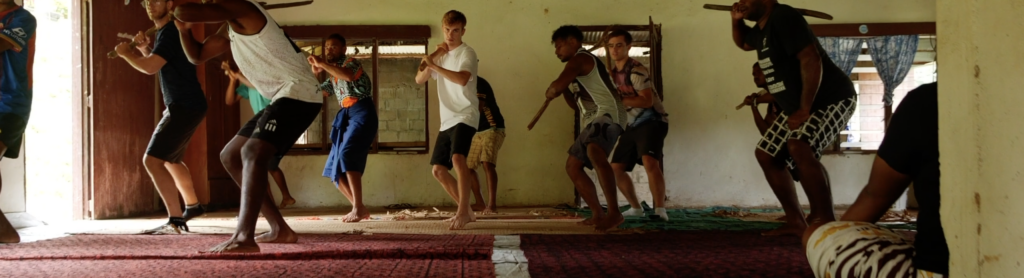
The Culture Course is an experiential learning programme as standard with any rural Think Pacific project in line with requests from the Ministry of iTaukei Affairs. You will be immersed in rural Fijian culture throughout your project but this course intentionally goes deeper! Through immersion, the course aims to educate project participants about the nuances of indigenous Fijian culture through structured sessions delivered by members of the community youth group themselves and Think Pacific leaders.
Purpose
The course is set up to encourage an appropriate mindset from participants during the project, facilitate a meaningful experience for you but also works towards wider goals set out by the Ministry of iTaukei Affairs.
Fijian culture can be identified firmly as being an oral tradition – cultural knowledge is not written down and is transferred from generation to generation! A fear for many in Fiji’s current cultural climate that young people are not engaging with integral aspects of local custom and culture and knowledge is being lost. In line with requests from the Ministry of iTaukei affairs, this initiative aims to stimulate engagement with and revitalise local customs and traditions amongst rural youth. It aims to harness a pride in one’s culture and upbringing as well as practicing skills and communicating knowledge that defines the region and Fiji more broadly.
It ensures that all involved are learning cross-cultural skills through experience which they can not only support the rest of the aims during the project, but they can also utilise moving forward. This is not a one way street however as through discussing elements of indigenous Fijian culture in depth, both parties (participants and community members) will be simultaneously engaging in a cross-cultural examination of what makes up ‘culture’ and ‘people’ more broadly, exercising skills in appreciating new perspectives through discussion and reflection.
In addition, it is a clear opportunity to provide those youth leading the course a leadership opportunity, giving them a further platform to develop their soft-skills and boost personal and professional development.
The FNDP and SDGs
Fiji’s National Development Plan
By understanding the richness of Fijian culture still present today, whether through appreciating the crux of identity in understanding the vanua or the immense community wealth engrained in Fijian society, it is obvious why preserving these intricacies are crucial for the development of the country. There is also an economic incentive as Fiji’s economy is largely dependent on tourism, much of which is fuelled by cultural experience. In addition, with traditional skills and practices still commonplace, they form the basis for income-generation in many communities. With these combined, it is no surprise that Culture and Heritage holds its own plan for preservation and development in Fiji’s National Development Plan.

Fiji National Development Policy 3.1.10 – Culture and Heritage
- Cultural heritage forms an essential part of Fijian identity, this includes language, food, rituals and arts.
- These need to be safeguarded and promoted for future generations.
- The National Culture Policy and National Culture and Education Strategy helps protect and preserve cultural heritage.
- The cultural mapping programme will be key to gather information on traditional knowledge and heritage.
- The use of local culture in the tourism industry will promote and protect cultural heritage and the “Fijian Crafted” campaign will help to promote cultural performances and traditional crafts.
- The Fiji Museum and the National Library will be upgraded thus contributing to the preservation of Fiji’s heritage.
- Artisan production will be scaled up to provide genuine and culturally appropriate goods to tourists.
- Cultural heritage sites will be protected.
The government aims to “protect and promote unique Fijian cultural heritage for sustainable development”
UN SDGs
The UN SDGs underpin Fiji’s National Development Plan. Although none of the 17 SDGs focuses exclusively on culture, it is integrated into a number of the goals and the ones below are particularly relevant to the outcomes of the FNDP found above:
- Target 4.7 refers to the aim to ensure that all learners acquire the knowledge and skills needed to promote sustainable development, including, among others, through education for global citizenship and the appreciation of cultural diversity and of culture’s contribution to sustainable development.
- Target 8.3 addresses the promotion of development-oriented policies that support productive activities as well as, among others, creativity and innovation.
- Targets 8.9 and 12.b refer to the need to devise and implement policies to promote sustainable tourism, including through local culture and products, and to the need to develop suitable monitoring tools in this area.
- Target 11.4 highlights the need to strengthen efforts to protect and safeguard the world’s cultural and natural heritage.
Intended Learning Outcomes
For You:
- Learn in-depth about the lifestyle, culture and traditional skills that make up rural Fiji and importantly understand how they all relate and why.
- Develop inter-cultural competency and the ability to successfully communicate within a foreign cultural environment.
- Adaptability to changes in your own and foreign cultures.
- Tolerance: while working in teams, learn to listen more attentively, to respect each other’s opinion, team-work and team-spirit.
- Personal Skills: personability and set-up of sessions allows you to grow in confidence and communication.
- Appreciation of diversity: appreciation of the opinions and values of others, sensitivity to cultural diversity, and becoming more aware of your own culture.
- Broader Perspective: Reconsider the cultural framework you have been brought up in and acquire skills that will enable you to observe and analyse encounters with diversity and to extend these beyond the framework of your culture.
- Critical thinking.
For Community Youth Members
- Pride in their culture and upbringing and the practicing of traditional skills and knowledge.
- To encourage personal growth in the form of a boost in confidence, communication skills, team working, leadership, time management and presentation skills.
- Financial support for those involved and the youth group of the community.
- Any outstanding individuals can be highlighted for scholarship / employment opportunities
- Appreciation of diversity: appreciation of the opinions and values of others, sensitivity to cultural diversity, and becoming more aware of their culture.
- Broader Perspective: Reconsider the cultural framework they have been brought up in and to acquire skills that will enable them to observe and analyse encounters with diversity and to extend these beyond the framework of their culture.
- Critical thinking.